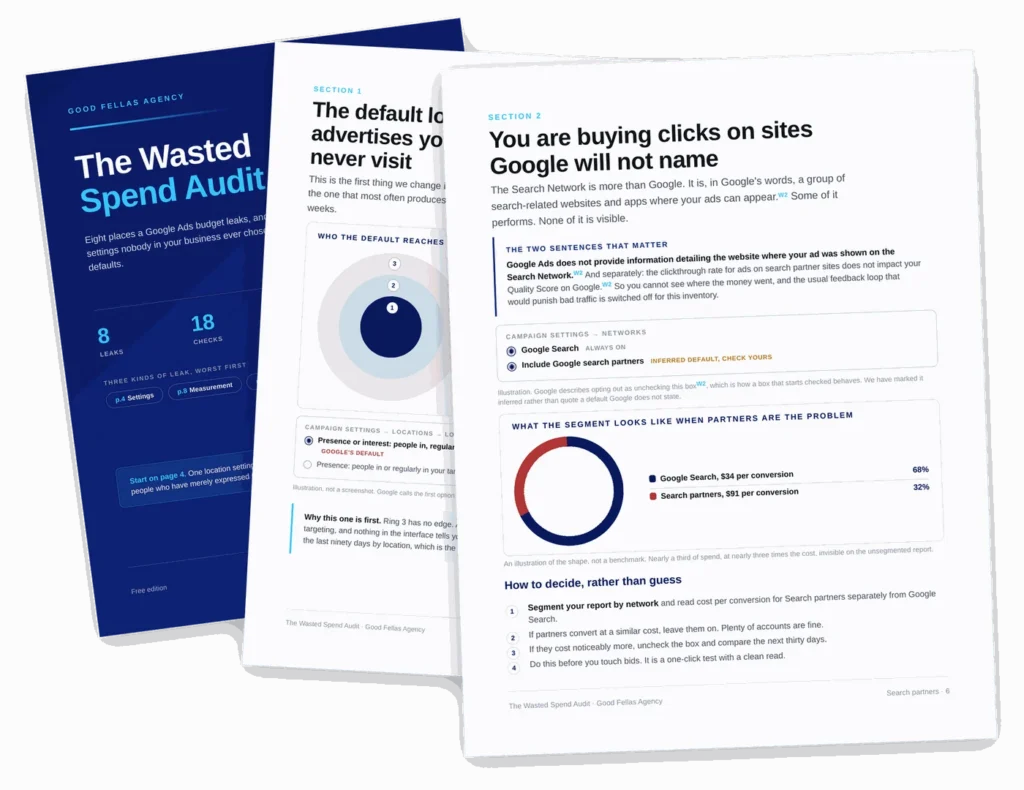
The document
Nobody decided to spend money this way. The settings did.
Negative keywords get the attention because they are the leak you can see in a report. These eight are the ones you cannot, because most of them were set before anybody was paying attention and have never been looked at since.
Fifteen pages, six Google sources quoted sentence by sentence, a twenty-point settings worksheet and a reconciliation that accounts for one month of spend line by line.
What is inside
Eight leaks, and the first one is a setting you never chose
Each section gives the Google sentence behind the behaviour, the date we checked it, and what to do about it. Where we reasoned from a rule rather than quoted one, the page says so.
Location, the default
Google’s default location setting reaches people who have merely shown interest in your area, from anywhere. Drawn as three rings so you can see what you are buying.
Search partners
Google states it does not provide information detailing the website where your ad was shown, and that partner clickthrough rate does not affect your Quality Score.
Display inside Search
Display traffic spending a Search budget and reported in the same rows. We do not claim it is on by default, because Google does not say so. We tell you how to look.
What counts as a conversion
Only primary actions go in the Conversions column and get bid on. Mark a page view primary and the bidding will go and buy you page views. The quietest leak here.
Schedule and devices
Device is the only bid adjustment that reaches minus one hundred percent. Everything else stops at minus ninety, which means you cannot switch a city or an hour off with a bid.
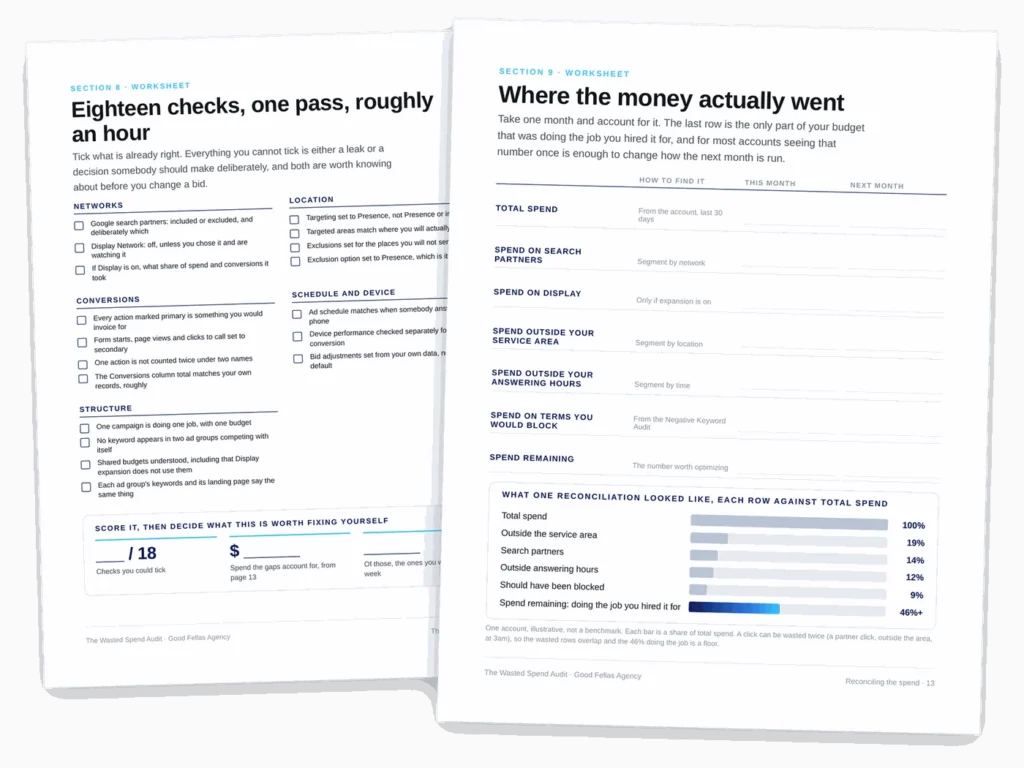
Two worksheets
Twenty settings checks grouped by where they live, and a reconciliation that takes one month of spend apart into partners, Display, out-of-area, out-of-hours and the rest.
How it works
Settings first, structure last, and measure between them
The order matters more than the individual fixes, because every structural change resets what the bidding has learned and you lose the ability to tell which change did what.
By the numbers
What you are getting
Before you ask
Questions people send us about this one
How is this different from the Negative Keyword Audit?
That one covers the searches you are paying for. This one covers the settings underneath them. They are independent: you can fix every setting here and still be buying irrelevant searches, or block every bad search and still be paying for clicks in another state at three in the morning.
What percentage of my budget is being wasted?
We will not tell you, and nobody honest will. Every figure in circulation is somebody’s sample presented as a law. The reconciliation worksheet totals yours from your own account in about twenty minutes, which is worth more than any benchmark because you can act on it tomorrow.
Should I just turn off search partners?
Not blind. Segment your report by network and read cost per conversion for partners separately. Plenty of accounts are fine. The reason it is in the document is that Google does not tell you which partner site you paid for, and partner clickthrough rate does not feed your Quality Score, so the usual feedback loop is absent.
I use an agency. Does this still apply?
It is a reasonable list of questions to ask one. A good agency will have an answer for each of the eight and will show you the segmented data behind it. If the answer to the location question is that it has always been on the default, that is worth knowing.