The document
Seven things a prompt needs, and the one most people leave out
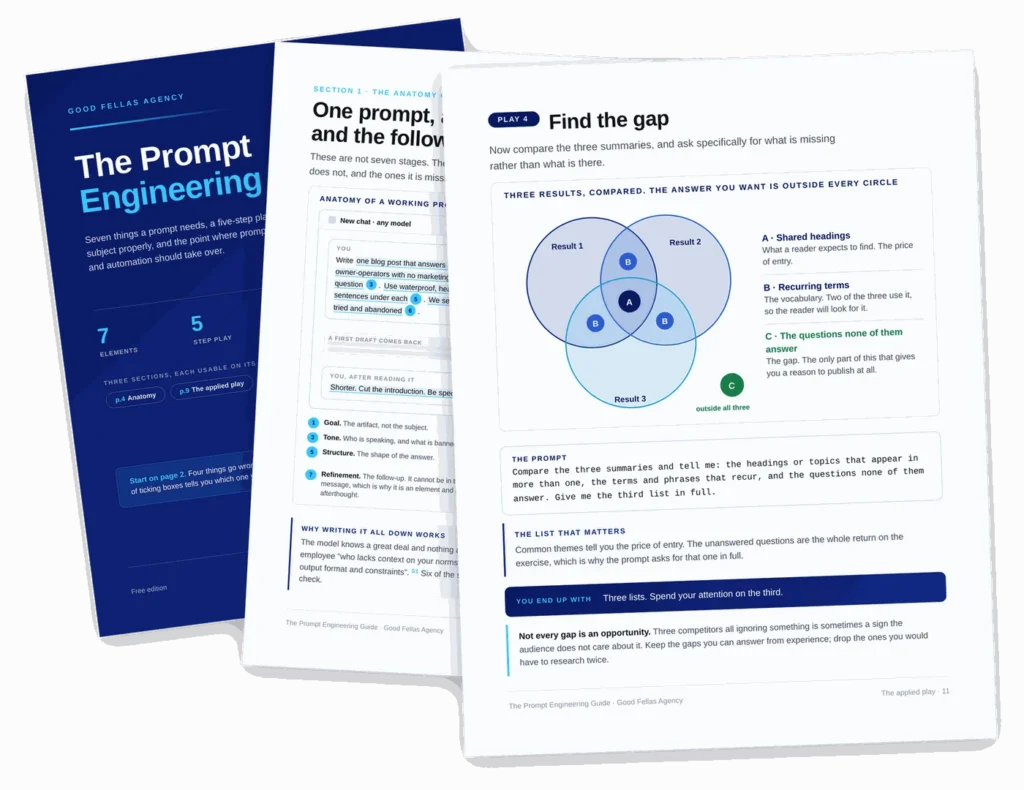
Most disappointing AI output is a prompt problem rather than a model problem, and the fault is usually one of seven specific omissions. The guide names all seven and shows what each looks like written down.
It also carries a five-step research play and a section on the point where prompting should stop and a rule should take over, which is the part almost no AI guidance covers.
What is inside
Three sections, each usable on its own
You can read any one of these without the others. Which one you need depends on whether the problem is the prompt, the research behind it, or the fact that you are doing the same thing by hand every week.
The anatomy
Seven elements a prompt either has or does not. The ones missing predict exactly how the answer will disappoint you, and each is shown written down rather than described.
Worked examples
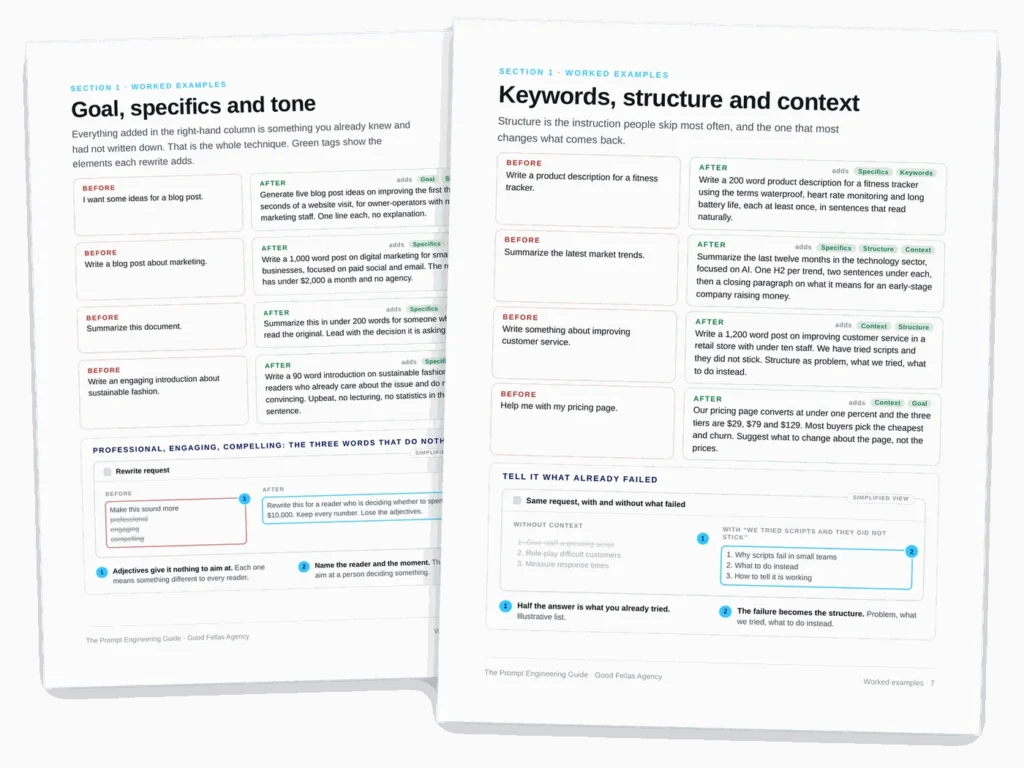
Nine before and after pairs across goal, specifics, tone, keywords, structure and context. Everything added is something you already knew and had not said.
The review loop
Five questions to ask a draft before you either use it or start again, and why replying beats restarting.
The research play
Five prompts in sequence that build an outline from what is already ranking rather than from what the model assumes about the subject.
Prompt to workflow
Parameterising a prompt you re-run, chaining, where a prompt sits in a process, and when a model is the wrong tool entirely.
Six templates
Product description, blog post, landing page, email, rewrite and critique. Fill the brackets and all seven elements are already present.
How it works
Start from what is going wrong
The guide opens on a two-minute diagnostic rather than a contents page, because the four common complaints about AI output have four different causes.
By the numbers
What you are getting
Before you ask
Questions people send us about this one
Is this tied to one AI tool?
No. Everything in it works the same way in ChatGPT, Claude or Gemini, because it is about what you hand the model rather than which model it is. There is a section on what the newer models changed and what they did not.
I already prompt reasonably well. Is there anything here?
The research play in Section 2 is the part experienced users tend to find new. It is five prompts in sequence rather than one, and the fourth one, which asks specifically what the competition has not answered, is where the value sits.
Does it cover automation?
Section 3 does, and it is deliberately honest about the limits. A working automation is mostly rules with a model at the one or two points that need reading comprehension, and the section says which tasks should never go through a model.
How long does it take to work through?
The diagnostic is two minutes and Section 1 is about ten. The research play takes an afternoon the first time you run it and considerably less after that.