The document
Every field is a decision you are asking a stranger to make
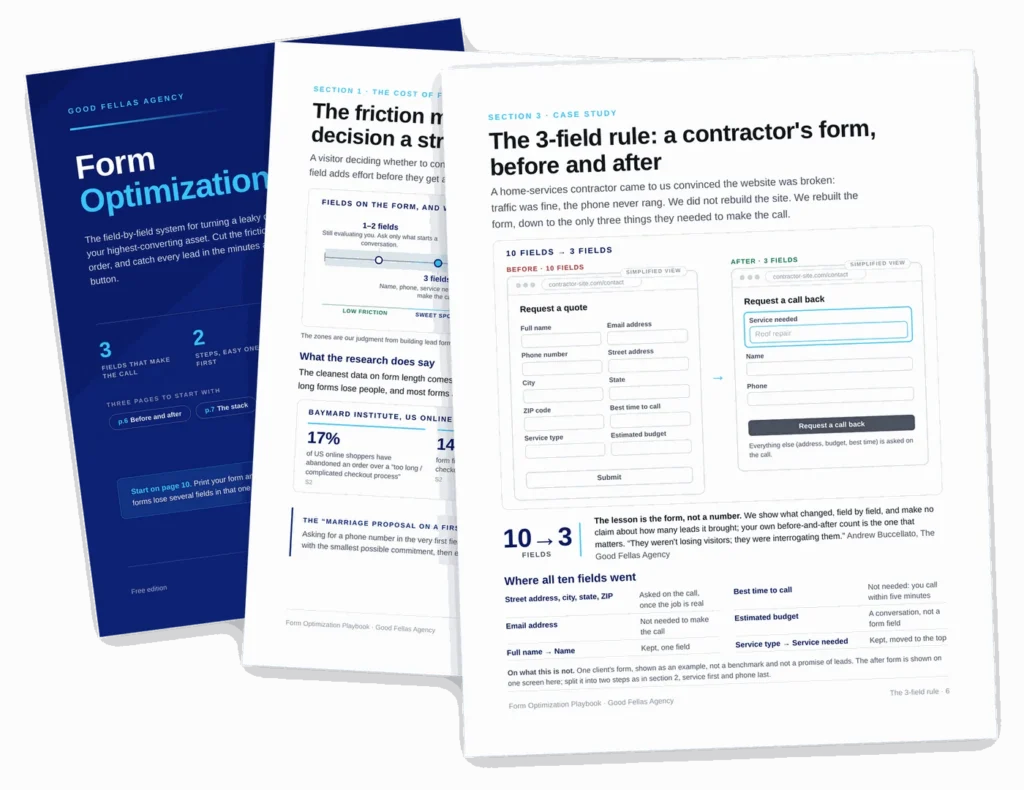
Six diagnostics on why people abandon forms, with the field-by-field changes that stop it. The friction meter at the front places your current form on a scale before you change anything.
It covers the two-step intake, the response window that decides whether a lead qualifies, and a worked case study where a ten-field form became three.
What is inside
Six diagnostics, from the friction meter to the response window
A form is usually the last thing on a page and the first thing to lose a lead, which is why it gets its own document.
The friction meter
Where one to three fields, the three-field sweet spot and the seven-plus danger zone sit, and what each band costs in completions.
The two-step intake
Why one effortless question first and an escalation after beats a shorter single-step form, and the psychology behind the effect.
Smart routing and the five-minute rule
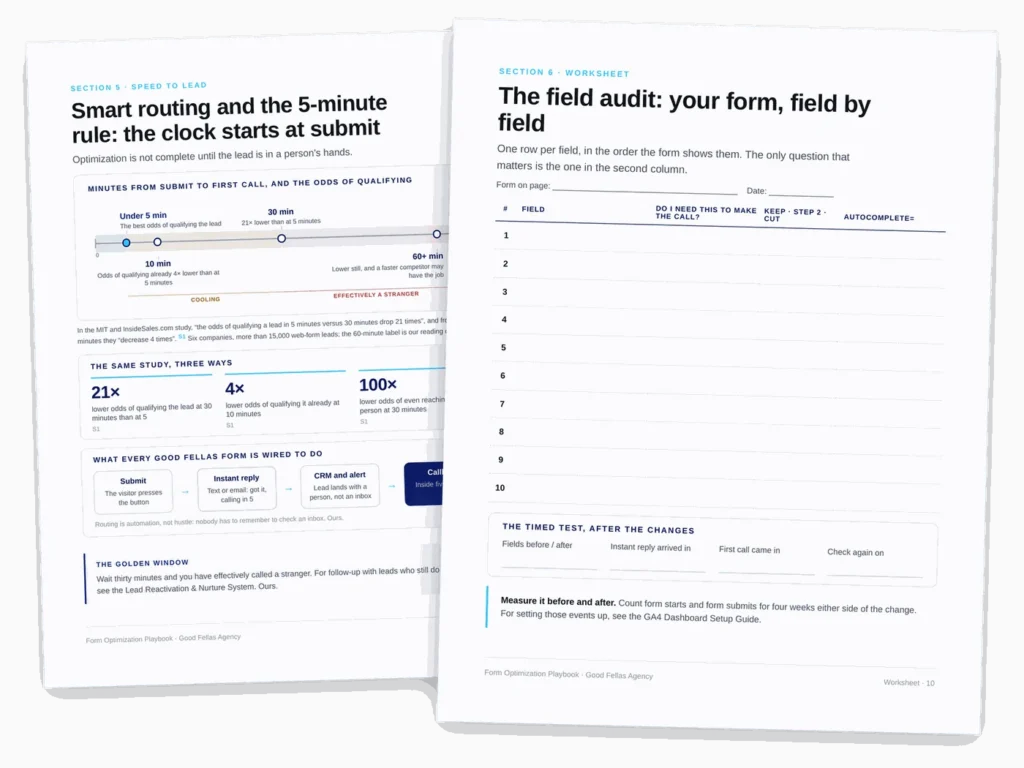
The response window: 21 times more likely to qualify under five minutes, falling steeply after. Wiring the form so nothing sits in an inbox.
The three-field rule
A home services contractor’s ten-field form reduced to name, phone and service needed. Leads doubled with no rebuild.
The optimisation stack
Four moves in order: reduce fields, add conditional logic, enable autofill, fire an instant confirmation. Then call inside five minutes.
The four numbers
Eleven percent lost per field, a two to three times two-step lift, 21 times on the five-minute window, and three as the field count that wins.
A few of the fixes
Six changes from the playbook
Most of these are a settings change or a deletion rather than a development job.
The numbers behind it
What the research says
Before you ask
Questions people send us about this one
How many fields should a contact form have?
Three is the target: name, phone and the service needed. Each additional field is associated with an average conversion drop of about 11 percent, and forms carrying seven or more lose a majority of potential leads.
Does a two-step form really beat a shorter one-step form?
Usually, yes. Two-step forms are associated with two to three times higher completion. Opening with one effortless question lowers the initial ask, and people who have started are substantially more likely to finish.
What is the five-minute rule?
Leads called back within five minutes are around 21 times more likely to qualify than those contacted after thirty. It is handled by routing and automation rather than effort, which is why the playbook treats it as a build rather than a habit.
Will removing fields hurt lead quality?
In the case study it did not. A ten-field form reduced to three doubled the leads, and the qualifying questions moved to the phone call where they are faster to ask and easier to answer.