The document
A plan tells you what to write. It does not tell you how anything gets finished
This is not another content planner. You may already have ours. It assumes the plan exists and that nothing is coming out of the other end, which is where almost every stuck content operation actually is.
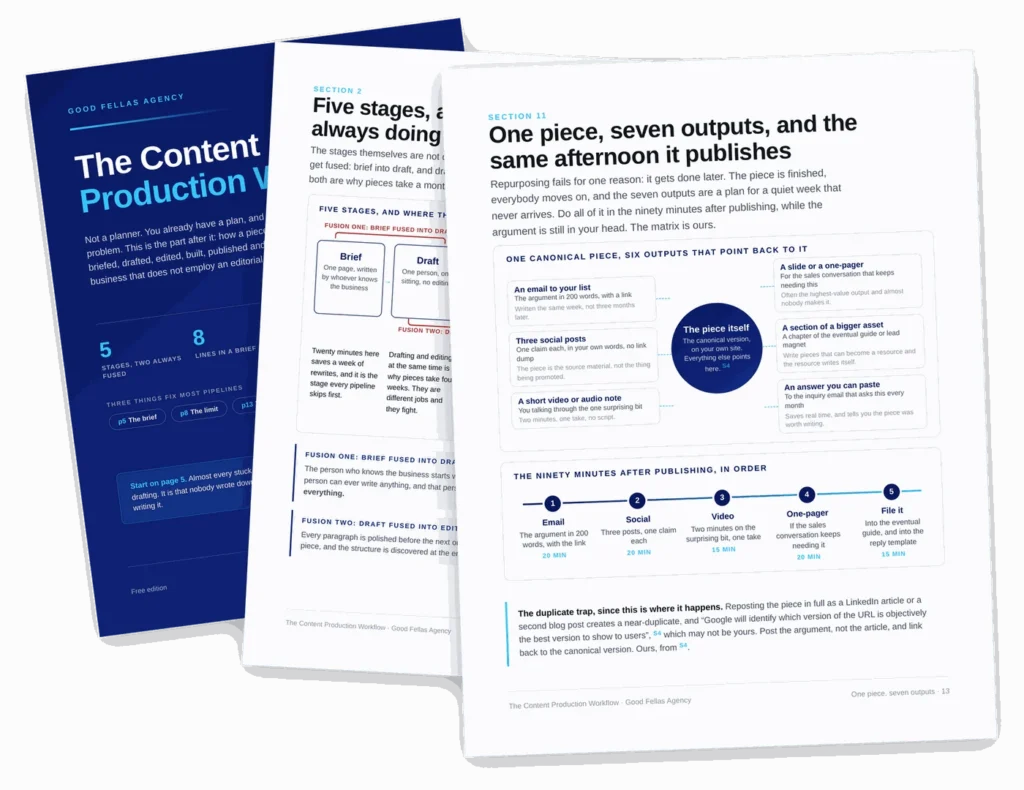
Twenty pages on the part after the plan: the eight-line brief, the five stages and the two that are always doing each other’s job, the work-in-progress limit that makes things finish, thirteen checks before publish, and seven outputs from every piece.
What is inside
Sixteen sections, and the brief is where most of the value is
Four sources are cited, all of them Google’s own documentation, at the four points where the pipeline has to meet a published standard rather than a preference. Everything else is craft and is labelled as ours.
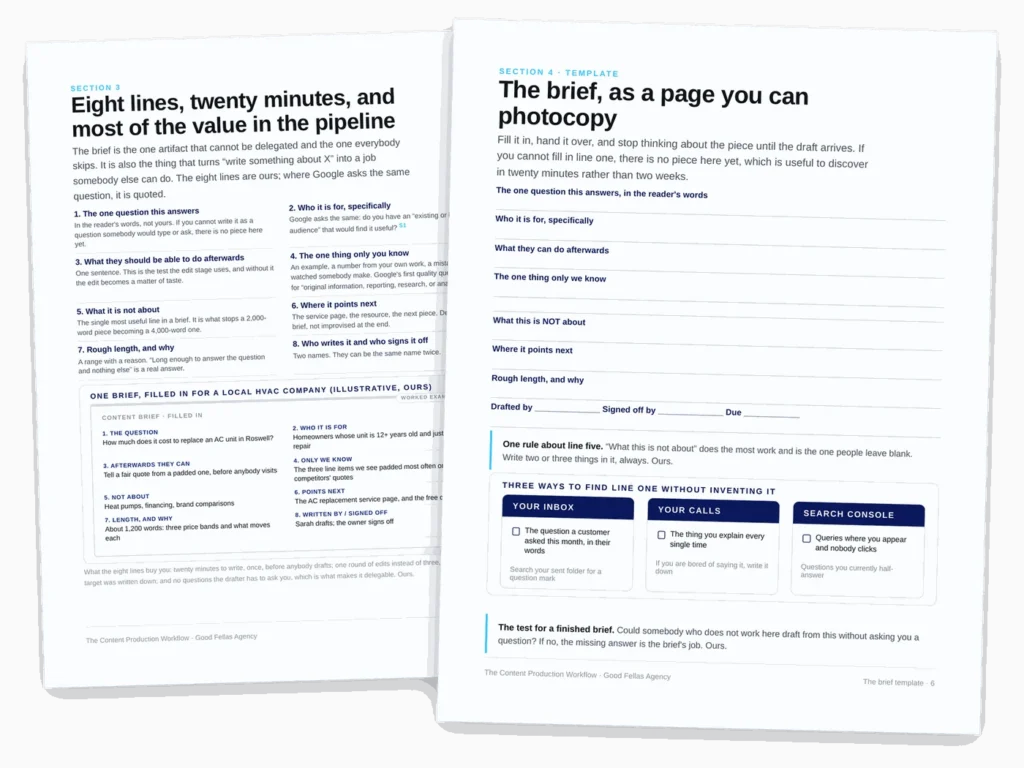
The eight-line brief
Twenty minutes, one page, and the thing that turns “write something about X” into a job somebody else can do. With a fill-in template you can photocopy.
The two fusions
Brief fused into draft is why the owner writes everything. Draft fused into edit is why a piece takes a month. Both feel like efficiency.
Two in flight, no more
Nine open pieces at an hour each publish nothing for six weeks. Two at four and a half hours each publish in two. Same hours, same people.
Thirteen checks before publish
A definition of done is what lets you hand the last stage to somebody else without reviewing their work. Four of the thirteen are Google’s own asks.
Google’s own edit checklist
The most underused free document in marketing. Its self-assessment questions make a better editorial standard than anything an agency will sell you, and they are quoted verbatim.
One piece, seven outputs
Done in the two hours after publishing, not in a quiet week that never arrives. Including the one almost nobody makes: the one-pager for the sales conversation that keeps needing it.
The rules that do the work
Six decisions, and none of them is about writing better
Every symptom of a stuck content operation arrives described as a content problem. Six of the seven in the last section are a missing rule, and the seventh is a missing spreadsheet.
By the numbers
What you are getting
Before you ask
Questions people send us about this one
How is this different from the Content Cluster Planner?
The planner decides what to write about: it turns scattered posts into topic clusters. The Social Content System covers the calendar and the content pillars. This one assumes both of those are done and answers a different question: why nothing is coming out of the other end. If your problem is deciding what to write, start with the planner. If your problem is that you know what to write and it is not getting written, start here.
Can I use AI to write the content?
Yes, and the document is specific about where. Google’s spam policy does not mention tools as the problem: scaled content abuse is “when many pages are generated for the primary purpose of manipulating search rankings and not helping users”, and it applies “no matter how it’s created”. So a tool drafting from your brief is ordinary use. A tool generating many pages without adding value is Google’s own example of the thing that gets punished. The one stage where a tool cannot help is the brief, which is the stage people most want to automate.
How often should we publish?
Work it out from the hours you have, not from what a competitor appears to do. The document costs a piece at roughly seven hours, of which about two belong to the person who knows the business, and gives three honest cadences against that. Two a month held for a year beats one a week held for five weeks, and we would also suggest not announcing the schedule until you have held it for three months.
We hired a writer and the work came back generic. What now?
Write three briefs before you hire anybody else, and hand over the fourth. A writer without briefs will produce generic work, be judged on it, and be replaced by another writer who produces generic work. The brief is what converts a writer from a liability into leverage, and the eight lines include the two that nobody writes: the one thing only you know, and what the piece is not about.
Do we need a project management tool for this?
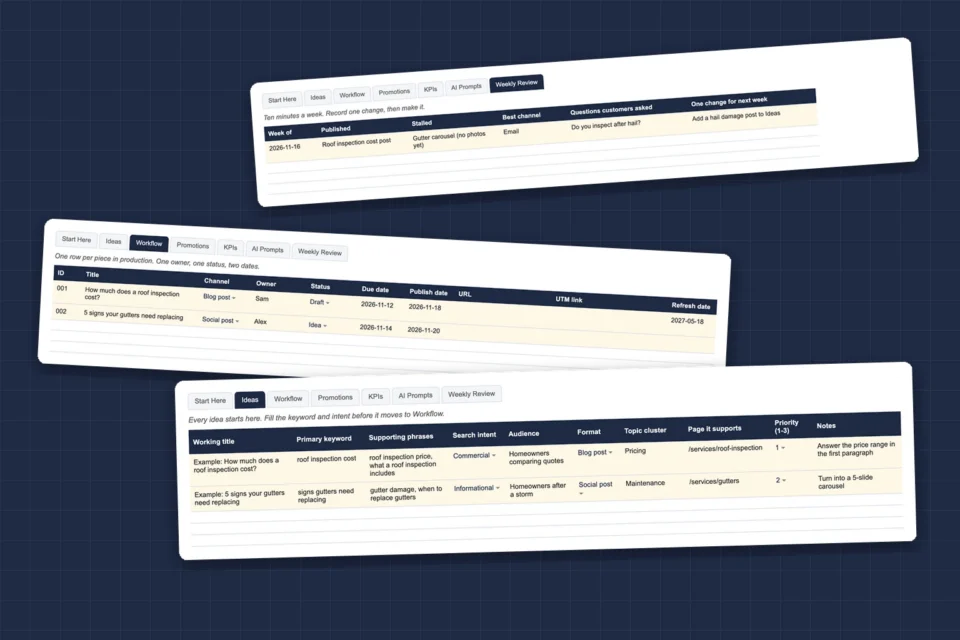
No, and the document argues against it. The tool is the thing that gets set up over a weekend and abandoned within a month. What survives is one row per piece with seven date columns: brief written, drafted, edited, published, distributed. Legible in ten seconds, a year later.