The document
The question is not whether to have one. It is what it is allowed to do
That decision normally gets made by whoever installed the widget, and never gets revisited. A bot answering your opening hours at eleven at night is obviously worth having. A bot guessing at warranty coverage is obviously not. Same technology, and the difference is entirely in what it was allowed to attempt.
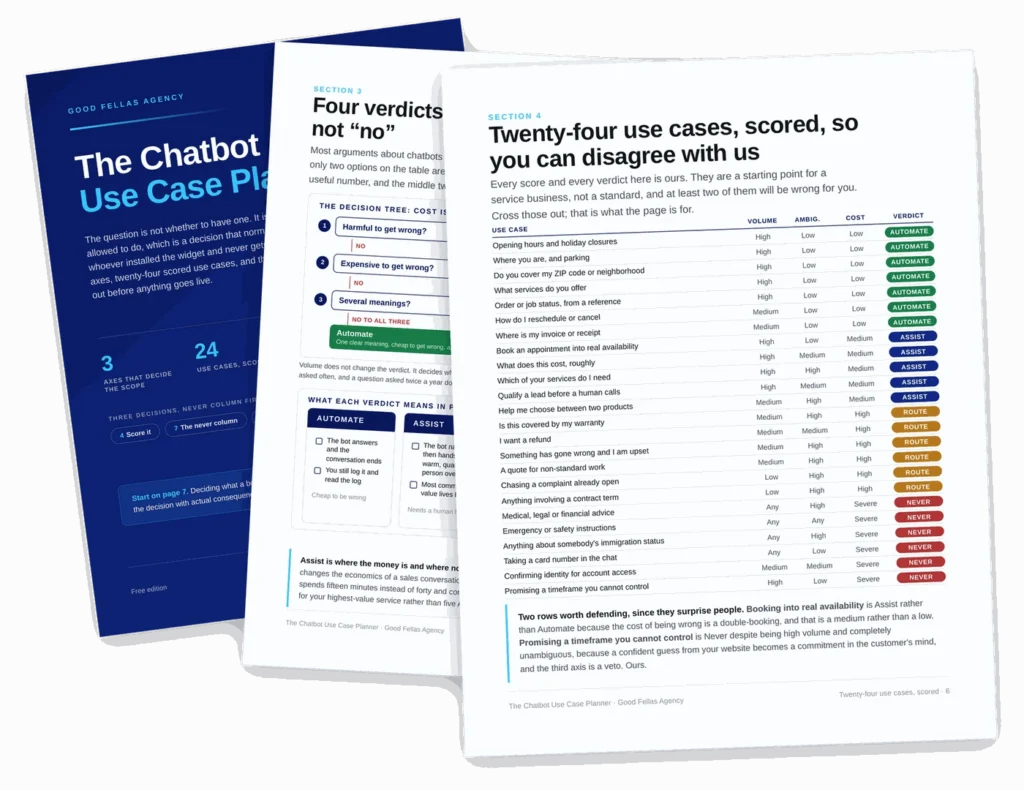
Twenty pages: three axes that produce a scope, twenty-four use cases scored so you can disagree with us, the six things to rule out before anything goes live, and what the law actually says rather than the version you have read.
What is inside
Sixteen sections, and the scoring is the part to argue with
Six sources are cited where the subject has exact requirements rather than opinions: two sections of the California bot statute, one article of the EU AI Act, and three WCAG success criteria. The scoring method and every verdict in it are ours, which means a row can be wrong for you and should be crossed out.
Three axes, one of them a veto
Volume, ambiguity, and the cost of being wrong. The first two tell you whether automation is worth the effort. The third overrules both, because volume never buys you permission.
Four verdicts, three of them not no
Automate, assist, route, never. Most arguments about chatbots collapse because only two options are on the table, and almost everything real lands in the middle two.
Twenty-four use cases, scored
From opening hours to warranty coverage to taking a card number. Each with a volume, an ambiguity, a cost and a verdict, all ours and all arguable.
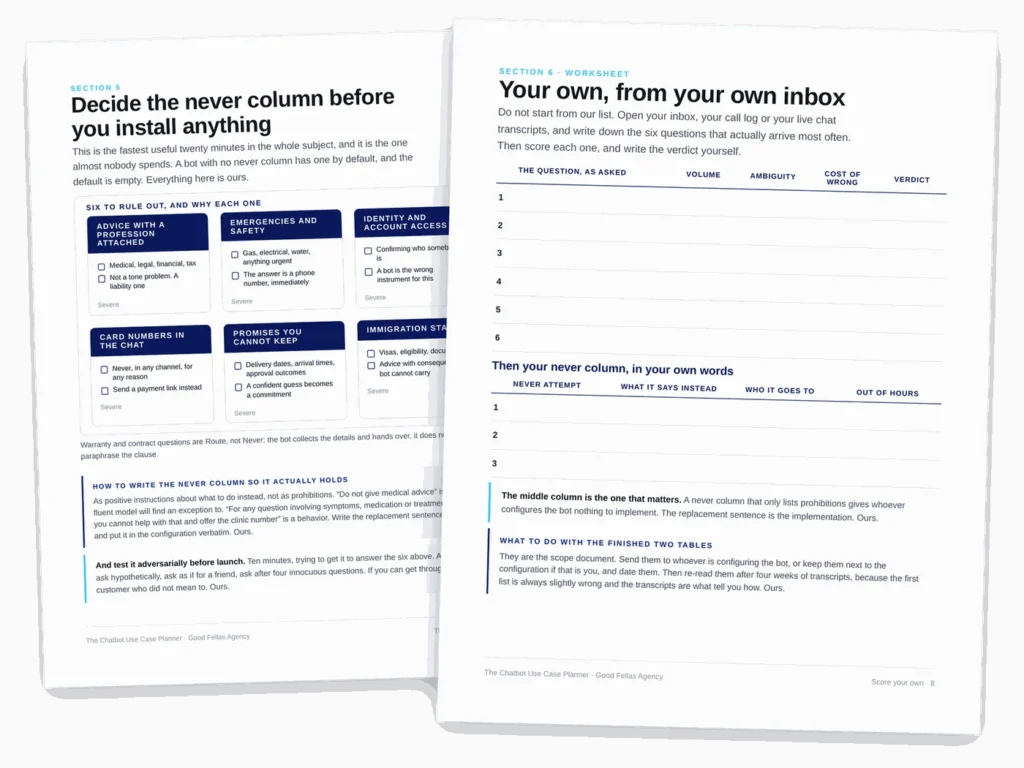
The never column
Six things to rule out before you install anything, written as behaviours rather than prohibitions, because a fluent model will find an exception to a prohibition.
The handoff is the product
Every bot people hate has the same two problems: you cannot reach a person, and when you do you start again. Six rules, and the transcript travels with the customer.
What the law actually says
California’s statute is an intent-based prohibition with an explicit safe harbour, not a blanket disclosure duty. Reading the real sentence turns it into one line of configuration.
Decisions, not features
Six things to settle in twenty minutes, before anything goes live
None of these is a technology choice, which is why changing vendor almost never fixes a chatbot anybody is unhappy with.
By the numbers
What you are getting
Before you ask
Questions people send us about this one
Do I legally have to say it is a bot?
Not in the way you have probably read. California’s statute makes it unlawful to use a bot “with the intent to mislead the other person about its artificial identity” in order to incentivize a sale or influence a vote, and it carries an explicit safe harbour: “a person using a bot shall not be liable under this section if the person discloses that it is a bot.” So it is not a blanket duty, and disclosing is the named way out. The EU AI Act is closer to a straight transparency obligation if anybody in Europe can reach your site. Either way the practical answer is the same and it costs you one line of configuration. We are not lawyers and the document says so.
What should a chatbot never be allowed to do?
Six things, and the document argues each one: advice with a profession attached, emergencies and safety, confirming somebody’s identity, taking a card number, promising a timeframe you cannot control, and anything a contract governs. The important part is how you write the rule. “Do not give medical advice” is a prohibition a fluent model will find an exception to. The replacement sentence, written out in full and pasted into the configuration, is a behaviour.
Will it reduce how much time we spend answering enquiries?
Yes, and not in the way vendors describe. In a small business it does not reduce headcount; it moves the same work out of interruptions and into a log you read once a day, which is worth real money in attention rather than in salary. The one genuine new-revenue case is the enquiry that arrives at eleven at night and currently waits until Tuesday.
Our vendor reports 84% containment. Is that good?
Unanswerable on its own, which is why it is the number to distrust. Containment goes up when the bot is good, and it also goes up when the bot is so bad that people give up. Those are identical on a dashboard. Look at total enquiries over the same period instead: 84% with enquiries flat is good news, and 84% with enquiries down a fifth means you have installed a filter on your own pipeline.
What do we need before we can switch one on?
Content. A bot cannot answer a question your website has never answered, and that is the discovery that kills most deployments in week two. Every row in your automate column needs one canonical answer that exists, is current, and is written down. The fortnight spent writing those is content the site needed anyway, and some clients have got more out of that than out of the bot.