The document
Google’s rules do not transfer, and the objective is the one you cannot edit
Meta replaced eleven campaign objectives with six, and left every existing campaign exactly where it was. Nothing was converted for you. Since October 2024 you cannot even add an ad set or an ad to one of the old ones.
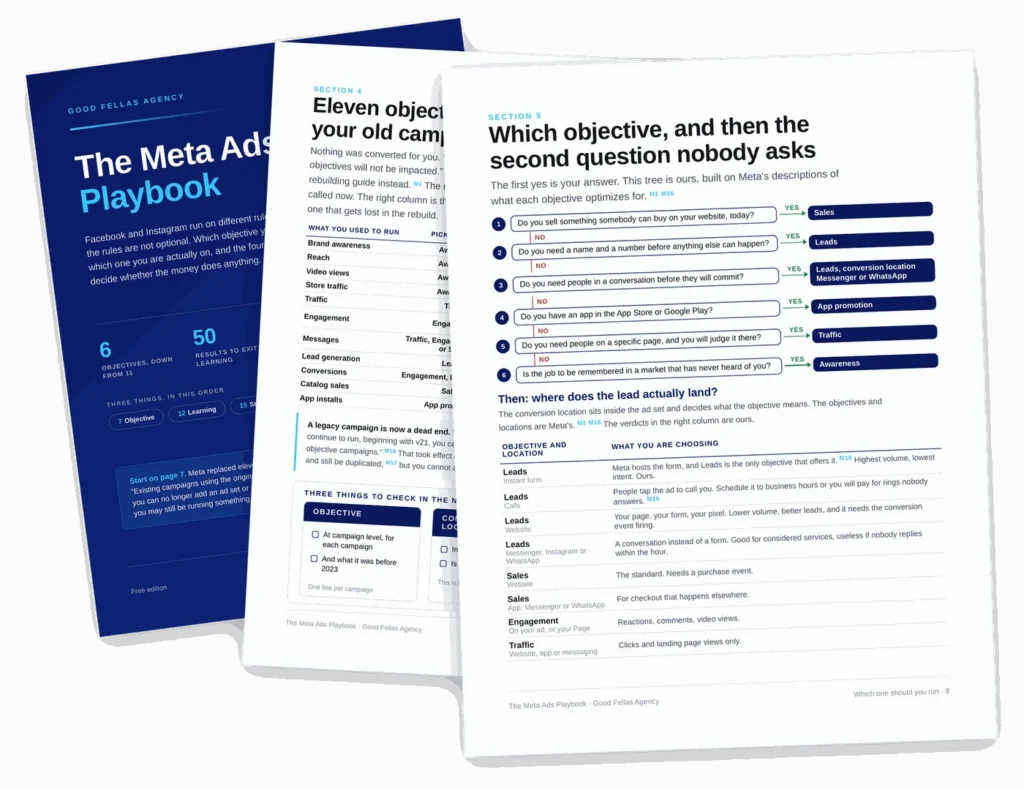
Twenty-six pages: all six objectives with what each honestly buys, a six-question decision tree, the complete list of edits that reset the learning phase, and the arithmetic that turns “what should my budget be” into a number.
What is inside
Sixteen sections, and the fourth is where the money is
Meta’s own documentation describes the objectives, the learning phase, the attribution windows and the ad limits. The decision tree, the eight tells, the thirty-day sequences and every verdict are ours, and the document labels which is which on every page.
All six objectives
Awareness, Traffic, Engagement, Leads, App promotion and Sales. What Meta says each does, what it buys in practice, and what it will not do however good your ad is.
The objective you inherited
The ten-row map from the old eleven to the new six, and the setting inside each that carries the meaning. A pre-2023 campaign is now a dead end you cannot add to.
Fifty results, one week
An ad set exits the learning phase after about fifty results in the week after its last significant edit. Below that it never stops guessing, and Meta tells you so in the Delivery column.
The nine edits
Six that reset learning for certain and three that depend on how big the change is, in Meta’s own words. Adding an ad is on the list, which is why the usual response to flat performance makes it worse.
The budget arithmetic
Meta publishes a ten-times rule and a fifty-results rule. Run both and you get a floor and an arithmetic minimum for your own market, which is more useful than anyone’s benchmark.
The placement trap
Meta’s own worked example: eleven opportunities, a $27 budget, and nine results at $3.00. Turn off the placement that looks expensive and you get eight at $3.25.
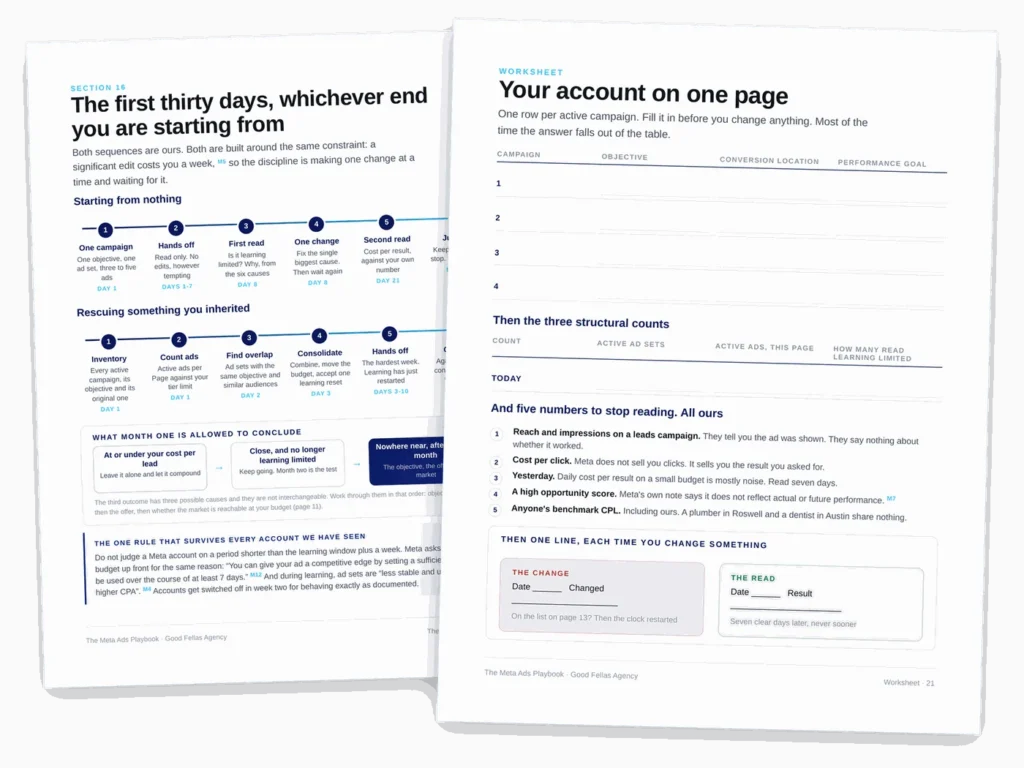
The order it goes in
Four things to check, and creative is last on purpose
Not because creative matters least. Because a brilliant ad on the wrong objective still fails, and you will blame the ad.
By the numbers
What you are getting
Before you ask
Questions people send us about this one
I already run Google Ads. How different can it be?
Different enough that the instincts which make a search account work will break a Meta one. In Google you buy searches somebody typed. In Meta you interrupt somebody who was not asking, the system chooses the surface rather than you, and the weekly tinkering that improves a Google account resets the learning phase here. The first section is five rules that do not transfer.
What minimum budget do I need?
We will not quote you one, and nobody honest will. Meta publishes two rules instead: a daily budget of at least ten times the cost of the result you are optimising for, and about fifty results in a week to stabilise. Run both against your own cost per enquiry and you get a floor and an arithmetic minimum in about five minutes. If the answer is above what you have, that is a real finding and it is cheaper in week one than in month four.
Meta says we got forty leads. Our CRM has eleven. Who is lying?
Neither, and attribution is probably not the main answer either. On an instant form Meta counts a submission the moment it happens, and your CRM only holds what the integration delivered, so the first thing to check is whether every lead actually arrived. Then duplicates and junk. Attribution windows come third, and they mostly apply to conversions on your own website. The playbook gives the order and explains all three windows.
Should I just turn on everything with Advantage+ in the name?
Placements, yes: Meta says they are typically the most efficient use of your budget, and its own worked example shows what restricting them costs. Audience, A/B test it, and not on a retargeting ad set, which Meta names as the exception. Campaign budget once you run more than one ad set, which is our view rather than Meta’s. The objective, the event you call a lead and the number that runs your budget are business decisions and should not be automated at all.
Is the advice in here sourced, or is it opinion?
Both, and it says which on every page. Nineteen Meta pages are quoted verbatim across four sources pages at the back, each one carrying a marker you can trace from the claim. Our judgement, including the decision tree and the diagnoses, is labelled as ours. We also had the whole document adversarially fact-checked before release and fixed ten things, one of which was a wrong premise we had carried into the first draft.