The document
A supplier’s advice is not neutral. That is ordinary.
Your accountant suggests more bookkeeping. Your builder suggests the better windows. Google suggests a larger budget and a wider match type. None of that makes anyone dishonest, and all of it means the recommendation needs reading rather than clicking.
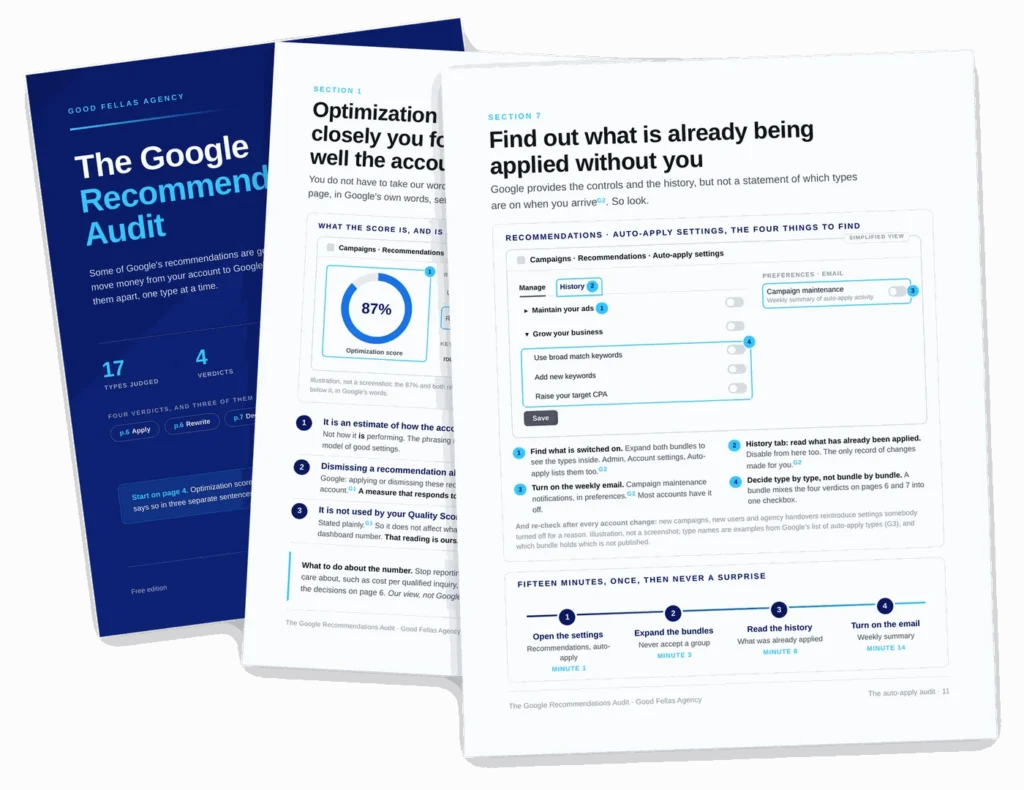
Fifteen pages, seventeen recommendation types judged one at a time, and three sentences from Google’s own documentation that settle what optimization score actually measures.
What is inside
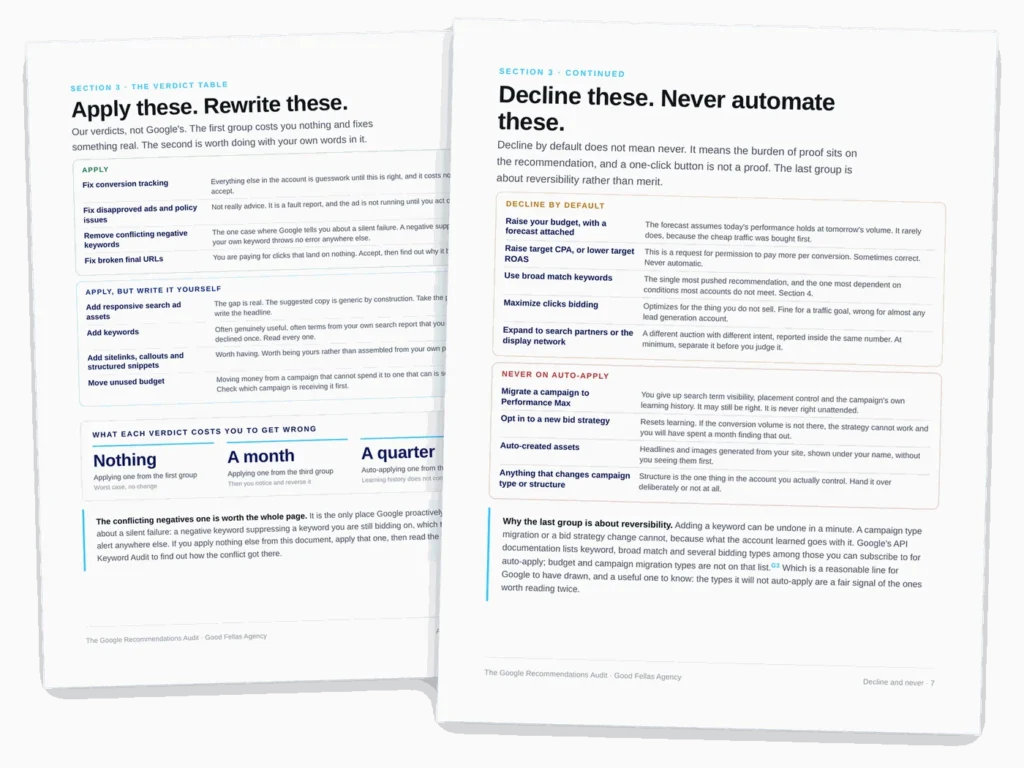
Four verdicts, and three of them are not yes
Every verdict in the document is our opinion and is marked as such. The statements about how Google Ads behaves are quoted from Google’s own pages with the date we checked them.
Apply today
Fix conversion tracking, fix disapproved ads, remove conflicting negative keywords, fix broken URLs. Free money, and the negatives one is the only place Google warns you about a silent failure.
Apply, in your own words
Assets, keywords, sitelinks and moving unused budget. The gap each one names is usually real. The copy it suggests is generic by construction.
Decline by default
Budget rises with a forecast attached, raising target CPA, broad match, maximize clicks, network expansion. Not never, but the burden of proof is on the recommendation.
Never unattended
Campaign migrations, bid strategy changes, auto-created assets. These are about reversibility rather than merit: what the account learned does not come back with you.
What the score measures
Google says it estimates how the account is set to perform, that applying or dismissing both change it, and that it is not used by Quality Score. Three sentences, one conclusion.
The auto-apply audit
Where to find what is already being applied without you, how to read the history, and the weekly email most accounts have switched off.
How it works
Three questions, asked before you read the reasoning
The reasoning printed beside the button is written to persuade. That is not a criticism, it is what reasoning beside a button is for. Ask these first.
By the numbers
What you are getting
Before you ask
Questions people send us about this one
Is this just Google bashing?
No, and it would be a worse document if it were. Four recommendation types are endorsed outright as free money you should click today. The value is the discrimination, not the suspicion. We also say plainly that we are a supplier too and our advice is not neutral either.
Should I be worried about my optimization score?
Less than you are. Google describes it as an estimate of how well your account is set to perform, says applying or dismissing a recommendation changes it, and states it is not used by your Quality Score. A number that moves when you clear the list is measuring the list.
Is auto-apply switched on in my account?
We will not tell you, because Google’s own page does not state which types are on by default and we could not verify it. What the document gives you instead is exactly where to look, how to read the history of what has already been applied, and how to turn on the weekly email summary that most accounts have off.
What about broad match? Everyone says it works now.
It does, in accounts that meet four conditions: conversion tracking you trust, enough conversion volume for the bidding to learn, a negative keyword list with real depth, and somebody who will read the search terms report weekly. If you cannot tick all four, the answer is not yet rather than no.