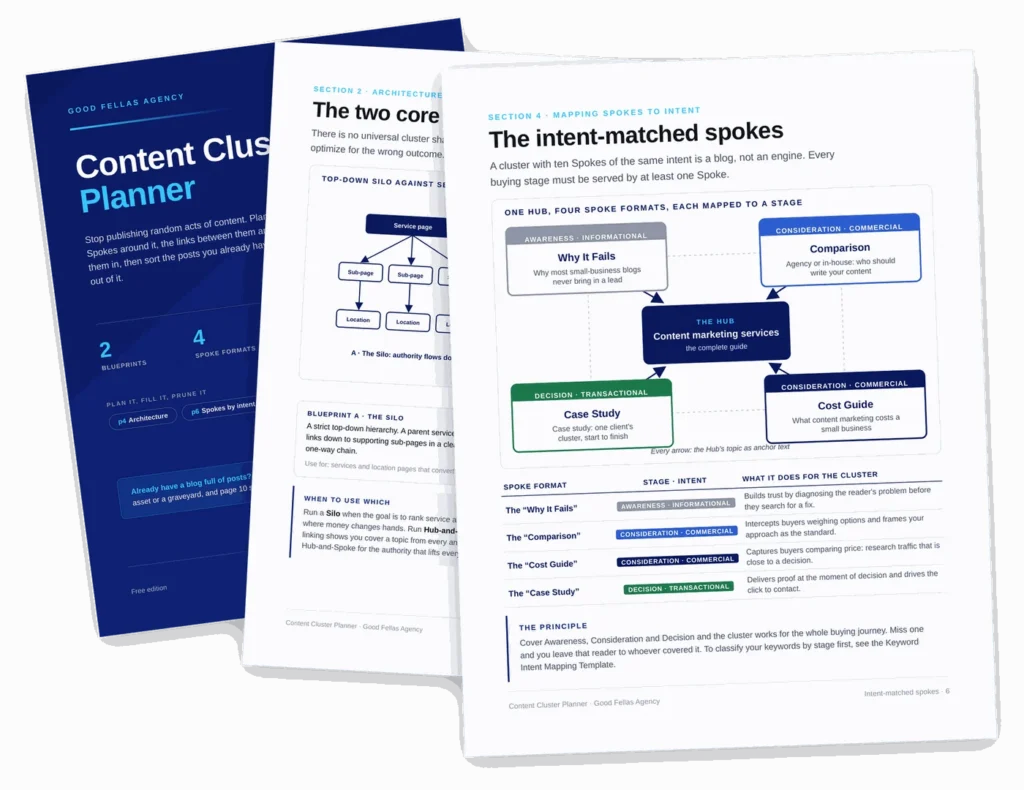
The document
One hub, five to ten spokes, and a reason for every link
A content cluster is a deliberately interlinked group of pages: one deep hub acting as the definitive resource, surrounded by spokes that each target a related long-tail term and link back with the exact phrase that matters.
Nine sections covering both blueprints, the anchor text discipline, an intent matrix for the spokes, and an audit for deciding what to keep from what you have already published.
What is inside
Nine sections, from architecture to the writer’s checklist
A cluster fails for structural reasons rather than editorial ones, so the planner spends most of its length on the structure.
The authority engine
Why a connected set of pages compounds and an isolated post does not, and what the hub actually has to be for the spokes to work.
Two core blueprints
Silo versus hub and spoke. One is a top-down hierarchy that converts, the other a semantic web that earns authority. Mature sites run both.
Anchor text discipline
The spoke to hub link uses the exact-match keyword rather than “click here”. It is the most under-used signal on most sites.
The intent-matched spoke matrix
Cost guide, why it fails, comparison and case study spokes mapped to real intent stages, so the cluster covers the whole journey.
The AI cluster architect
A copy-paste prompt that drafts a full ten-spoke plan with titles, keywords, intent and anchor text, plus the loop for refining it.
The content library audit
Five signs a library has gone stale, and a filter for deciding whether each old post is deleted, redirected or merged.
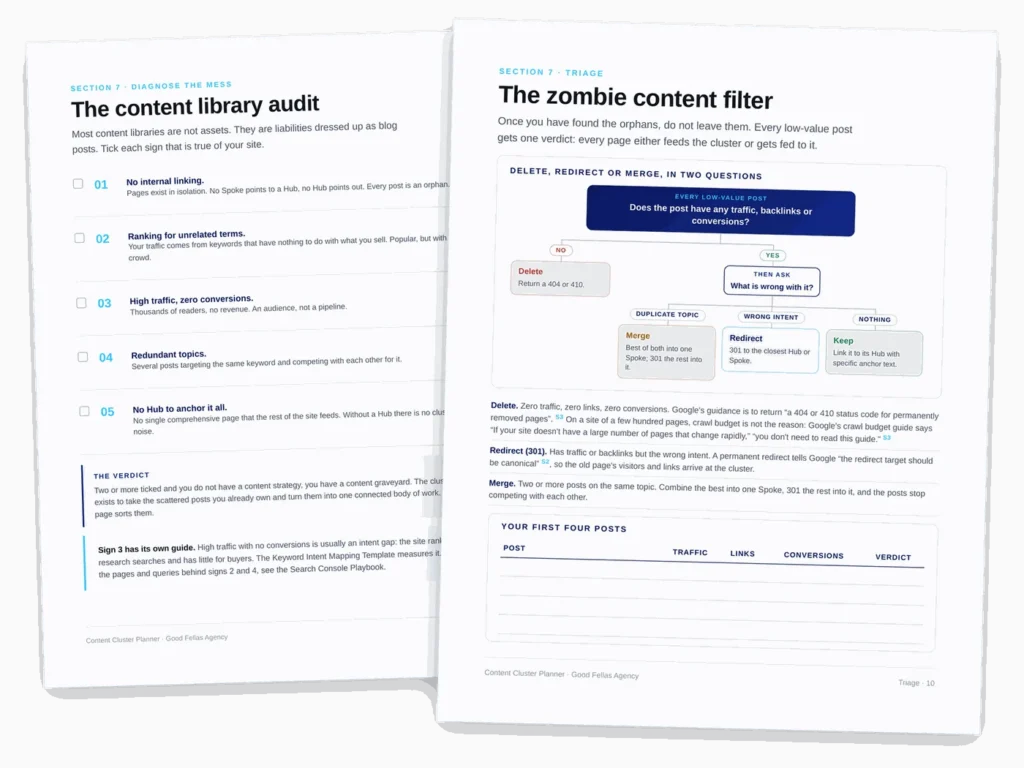
A few of the fixes
Six rules straight from the planner
Each one is a decision the planner makes for you, so the structure holds while the writing varies.
The numbers behind it
What the research says
Before you ask
Questions people send us about this one
What is a content cluster?
An interlinked group of pages: one deep hub acting as the definitive resource on a topic, surrounded by five to ten spokes that each target a related long-tail keyword and link back to it. The structure is what demonstrates topical authority.
What is the difference between a silo and hub and spoke?
A silo is a strict top-down hierarchy where authority flows one way, which suits service and location pages. Hub and spoke is a semantic web where hub and spokes cross-link, which suits owning a knowledge space. Established sites usually run both.
How many spokes should a cluster have?
Five to ten per hub, each on a different long-tail term and mapped to a different intent stage. A ten-spoke first draft is usually pruned to five or seven once overlapping terms are merged.
What anchor text should the spoke use?
The exact-match target keyword rather than “click here”, “read more” or “learn more”. The literal phrase is what tells a search engine what the hub is about, repeated from every supporting spoke.
Does this help with being cited by AI engines?
It helps because answer engines favour a page they can corroborate. A cluster gives them a primary source and supporting evidence they can verify in one crawl, where an isolated post gives them nothing to check it against.