The document
Paying for a website does not make you the owner of it
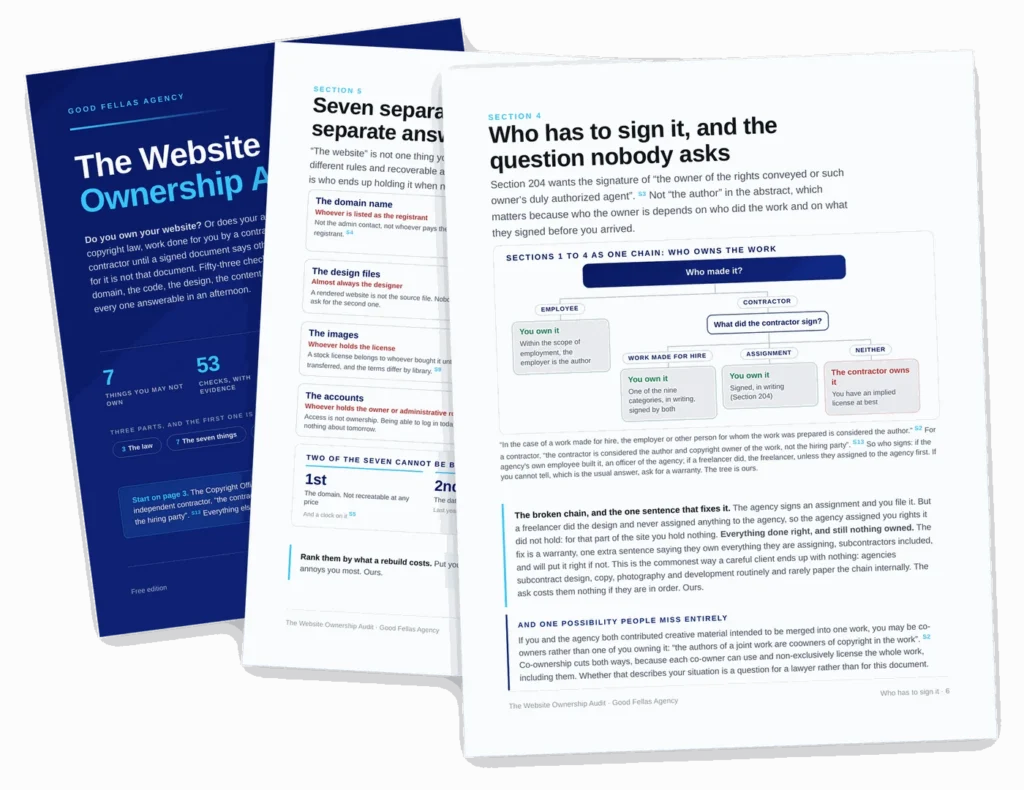
The Copyright Office puts it in one sentence. Where work is done by an independent contractor, “the contractor is considered the author and copyright owner of the work, not the hiring party”.
Twenty-three pages on what you actually hold: the domain, the code, the design files, the copy, the images, the data and the accounts. Fifty-three checks you can answer in an afternoon, most of them from your own inbox.
What is inside
Seventeen sections, and the first four are uncomfortable
The law is quoted from the statute and from the Copyright Office’s own circulars. The platform facts come from each vendor’s own help documentation rather than from anybody’s summary of it. Our judgement is labelled as ours on every page.
The default nobody reads
Copyright “vests initially in the author”. An invoice marked paid is not a conveyance, and a voluntary transfer is invalid unless it is in writing and signed.
Work made for hire, properly
Two routes in. If your own staff built the site you already own it. If a contractor did, the commissioned route needs one of nine statutory categories and a signature from everybody.
Chain of title
The commonest way a careful client still owns nothing: the agency assigns you rights it never took from the freelancer who did the work. One warranty sentence fixes it.
The domain, and its clock
The registrant is the owner; admin, tech and billing contacts are not. ICANN imposes a 60-day transfer lock after a change of registrant, and publishes two ways round it.
The platform trap
Wix says the content is yours and that the site “needs to be hosted and operated on Wix’s servers”. Squarespace publishes exactly what exports, and style settings and custom CSS are not on the list.
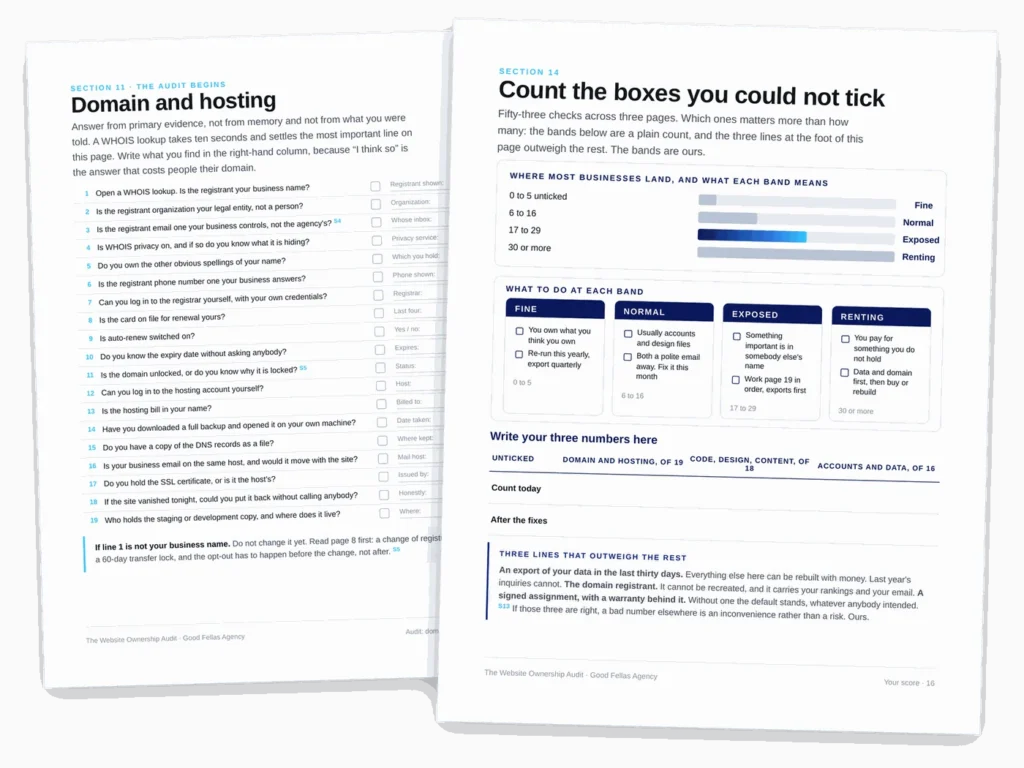
Fifty-three checks
Nineteen on the domain and hosting, eighteen on code, design and content, sixteen on accounts and data. Each with a box to tick and a line for the evidence.
Seven things, not one
“The website” is seven separate assets with seven separate answers
Governed by different rules, held by different people, recoverable at very different cost. Two of the seven cannot be bought back at any price.
By the numbers
What you are getting
Before you ask
Questions people send us about this one
Is this legal advice?
No, and the document says so twice. We are not lawyers. It is a reading of the published statute, two Copyright Office circulars, ICANN’s consensus policy and each platform’s own help pages, assembled so you can find out what you are holding and ask better questions. Anything with a dispute or real money attached is worth twenty minutes of an actual lawyer, and the completed audit is most of that first meeting.
My site is WordPress. Doesn’t the GPL mean I own it?
Not the part you are worried about. WordPress.org says derivatives inherit the GPL and that it considers plugins and themes derivative work, which genuinely gives you the right to use, change and redistribute code you hold, and to hire anybody you like to work on it. What it does not give you is a right to code nobody has handed over. A developer who built your theme and kept the files has not breached the GPL, because they never distributed anything. Ask for the files as a contract deliverable, not as a licence right.
We’re on Wix or Squarespace. Does any of this apply?
Differently, and the platform is usually honest about it in its own documentation. Wix says the content belongs to you and that the site has to run on Wix’s servers; both are true at once and the second one decides what happens if you leave. Squarespace publishes a list of what exports, and style settings, custom CSS and store pages are not on it, so the export is a content archive rather than a site. Neither is a reason to leave. They are reasons to own your domain and keep your own copy of the content.
What if the audit says my agency owns everything?
It is a common finding and usually not a hostile one. Most of the time nobody decided anything: the contract was silent and the statute filled the gap. The last section is four moves in order, starting with taking your data exports before you open the conversation, then the domain because it has a clock on it, then the assignment with a warranty behind it. Most agencies say yes, because most never meant to hold either.
How do I know the legal part is right?
Because you can check it. Fourteen sources are quoted across three pages at the back, each with its URL and the date we read it, and the two places where a passage was too long to quote in full are marked in square brackets and explained. We also had the whole document adversarially fact-checked before release and corrected twenty-five things, including a wrong opening proposition and a flat claim about the nine statutory categories that the Copyright Office’s own circular on websites does not support.