The document
A five-email sequence, a nine-word reopener, and the routing that catches the reply
Most businesses are sitting on dozens of enquiries that never became anything. They were rarely a no. They were a not yet, and nothing kept the conversation alive.
Six parts: the sequence itself with copy-paste templates, the reactivation message for leads who have gone quiet, and the automation layer that gets a reply to your phone rather than leaving it in an inbox.
What is inside
Six parts, from the first email to the routing
The templates are the part people use on day one. The trigger map is the part that makes it keep working without you.
The growth engine
Why this is a connected system rather than a newsletter, and the three jobs it has to do: build, nurture, reactivate.
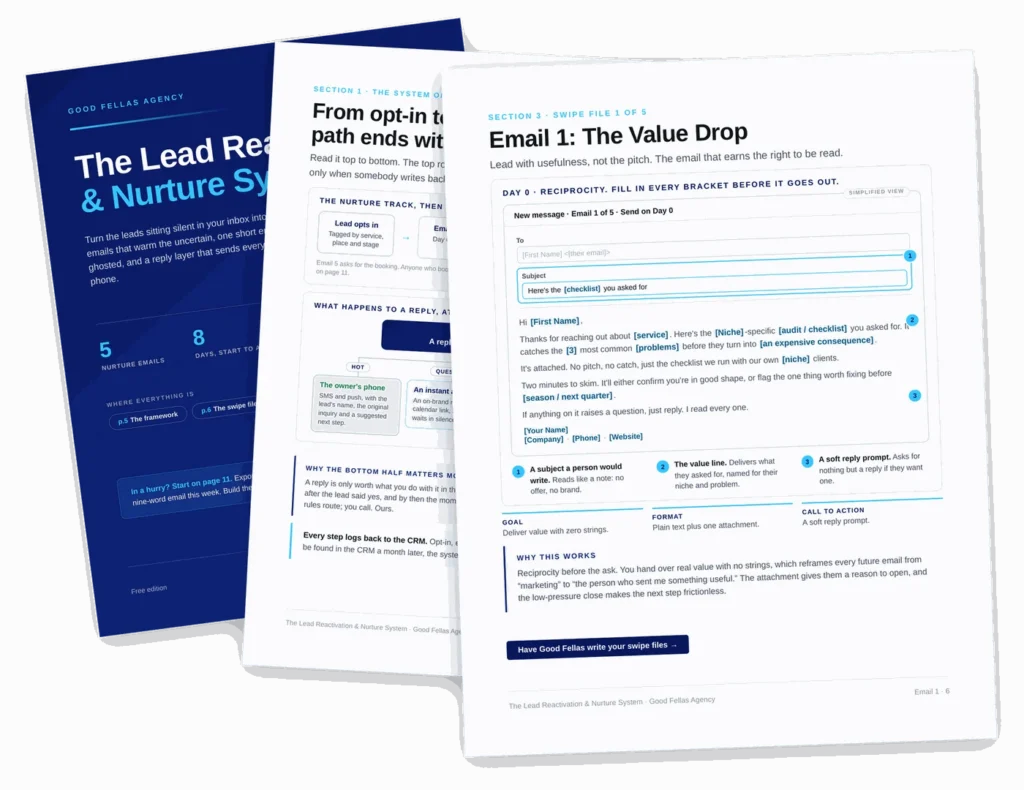
The five-email framework
Five emails across eight days, each mapped to a specific psychological job rather than a content slot.
The swipe files
Copy-paste templates for all five: the value drop, the proof, the human note, the objection, the close, with the fields to fill in.
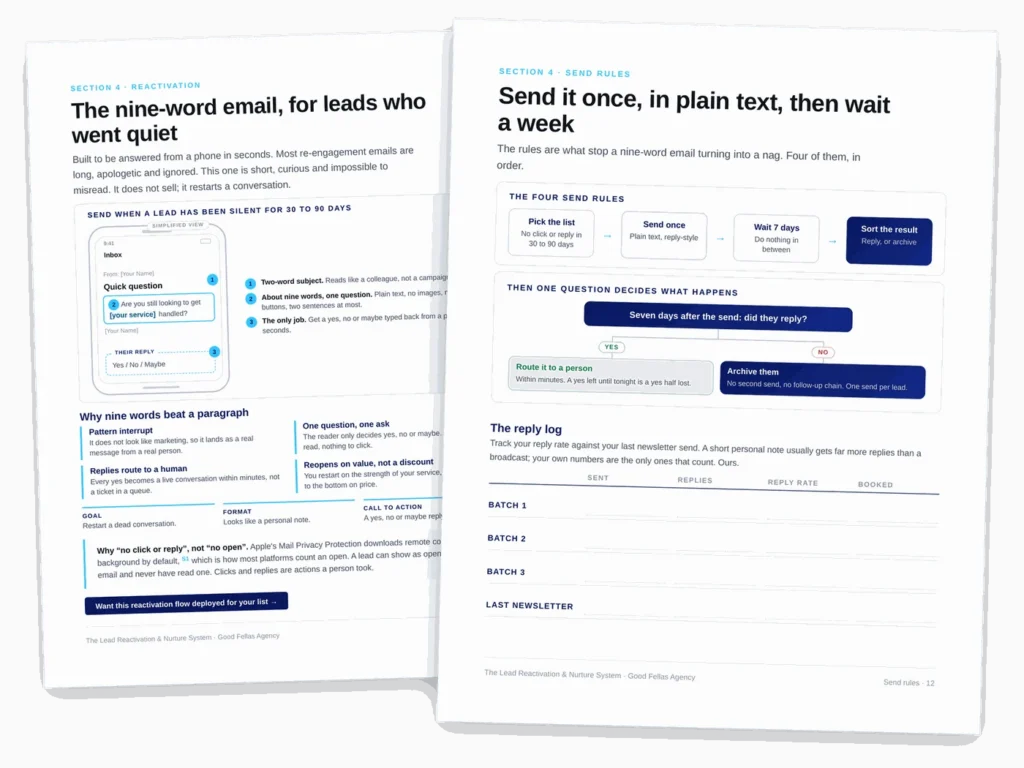
The nine-word reopener
A short plain-text message for leads who have gone quiet, with the send rules and the reply rate to expect.
The automation layer
Monitoring replies, routing a hot one to your phone, and syncing the rest to the CRM so nothing is lost in an inbox.
Execution and the trigger map
Segmentation by interest and location, plus the exact triggers that make the sequence run itself once tagging is right.
A few of the fixes
Six rules from the system
The sequence works because of its order and its restraint rather than its volume.
The numbers behind it
What the research says
Before you ask
Questions people send us about this one
How do you re-engage leads who went quiet?
A short plain-text message of around nine words, sent to people who enquired 30 to 90 days ago. It reads as a person rather than a campaign, which is why it sees reply rates of 15 to 30 percent against under two percent for a standard send.
How many emails should a nurture sequence have?
Five over eight days: the value drop on day nought, the proof on day two, the plain-text human note on day four, the objection on day six and the close on day eight. Each one has a job, which is what stops it becoming a newsletter.
Why do most enquiries never become customers?
Often because nothing followed the first exchange. A large share of enquiries never get a reply at all, and most small businesses are holding dozens of them. They were not refusals, they were conversations that stopped.
Do I need particular software?
No. The templates work in any mail platform, including Mailchimp, Klaviyo, ActiveCampaign, Kit or MailerLite. The routing layer is built with an automation tool, and it can be added later once the sequence itself is running.