
The document
Everything deciding the map pack is already public
Three profiles are above yours and every field that put them there is visible right now. Nobody looks, because the advice industry would rather sell a theory than ask you to open three tabs and write things down.
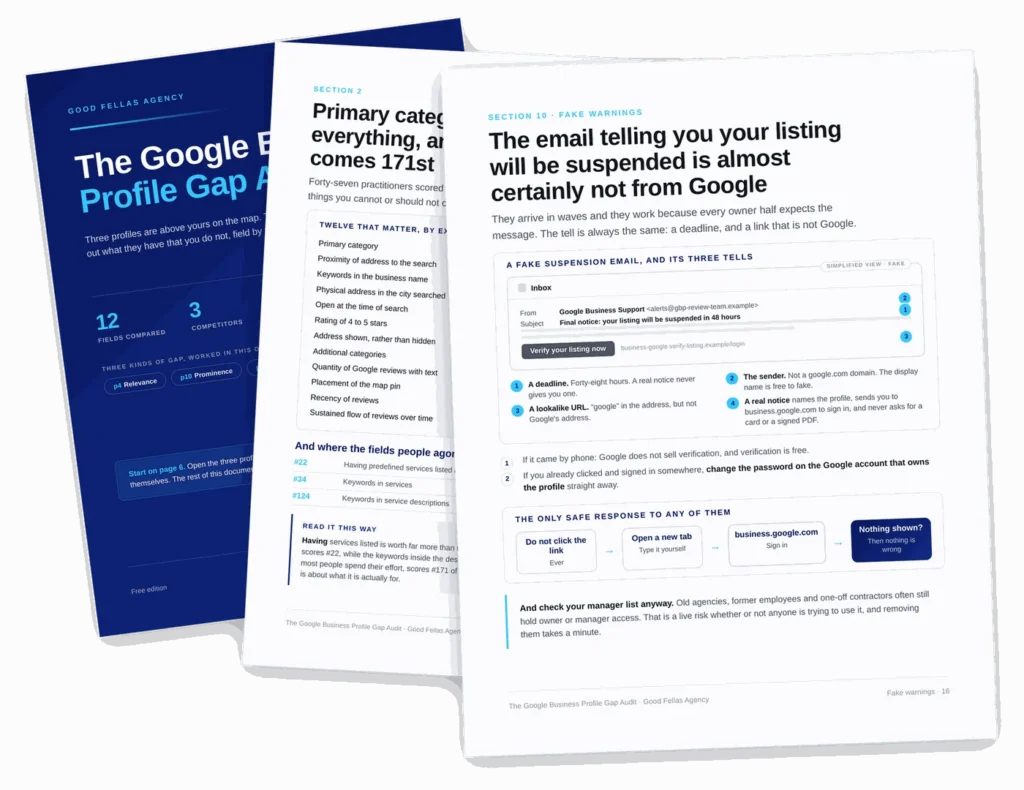
Twenty pages, built around a twelve-field worksheet you fill in against the three businesses actually beating you, with each gap weighted by how much it moves the map and how much it does not.
What is inside
Eleven sections, and you will not need all of them
The worksheet tells you which sections apply to you, which is usually three or four rather than eleven. Every ranking position quoted comes from a survey of forty-seven local search practitioners scoring 187 factors, and every rule quoted comes from Google’s own documentation.
The weight table
The top twelve factors in order, and where the fields people agonise over actually sit. Primary category scores first of 187. Keywords in the profile description score 171st.
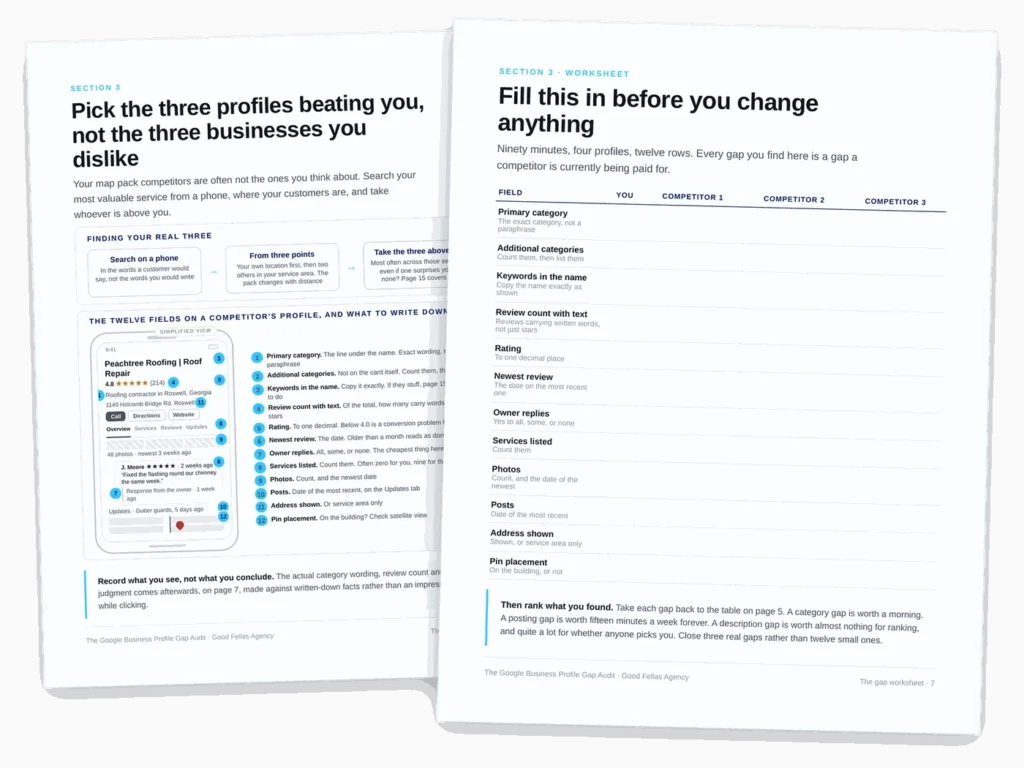
The gap worksheet
Twelve fields, four columns, your three real competitors. The centrepiece, and the thing nobody else gives away.
Categories and services
The highest-leverage field on the profile and the most under-used one. Having services listed is worth far more than the words inside them.
The three review numbers
Rating, written volume and recency are scored separately. A profile can be strong on one and losing on the other two.
Citations and the other maps
Apple, Bing, Yelp and Foursquare, plus how to find the listings carrying your old phone number. A wrong listing costs more than a missing one.
Suspension, honestly
The third most powerful ranking factor is a thing that will get your profile suspended. Both are true, and most guides only tell you the first half.
How it works
Find the gaps first, then decide which are worth closing
The order matters. Most profile advice has you changing things before you know which thing is losing you the work.
By the numbers
What you are getting
Before you ask
Questions people send us about this one
How is this different from the Local Visibility Playbook?
That one builds the profile right. This one works out why three competitors are above yours once it already is. If your profile is half filled in, start with the Playbook and come back here. If it is complete and you still are not ranking, start here.
Should I put keywords in my business name? My competitor has.
Keywords in the business name scored third of 187 factors, and Google’s guidance says unnecessary information in the name is not permitted and could result in suspension. Both are true at once. The document covers what to do about a competitor who is doing it, which is not to copy them.
I am a service-area business with no shopfront. Does the worksheet still work?
Yes. Showing an address rather than hiding it is itself a scored factor, so one of the twelve rows exists to tell you how much weight you are conceding by being service-area, and whether anything can be done about it.
How long before any of this shows up?
A category change usually moves the searches that find you within two weeks. Reviews and citations take months because Google’s own definition of prominence is built on them. Nothing here promises a position, and the document says plainly why anyone quoting you one inside thirty days has not looked at your profile.


